


Just Pour! - Water Sort Puzzle
robuminer
I usually judge a puzzle game by one simple question: does it make me want to solve one more level without making me feel as if I have started a second job? Just Pour! - Water Sort Puzzle aims squarely at that kind of short, low-pressure session. You sort colored water by pouring it between bottles until each bottle contains a single color. The idea is familiar, but the appeal comes from how quickly a round becomes a small planning exercise.
This is a free trivia-style game from robuminer, rated for Everyone and compatible with Android 7.0 or later. It has reached over 500 thousand installs and holds a 4.5 average from around 872 ratings, which suggests that its straightforward format has found a sizeable audience. I see it as a game for people who want something calm and immediately understandable rather than a story, competitive ladder, or action challenge.
How to decide if this water-sorting game suits you
The first few minutes tell you almost everything
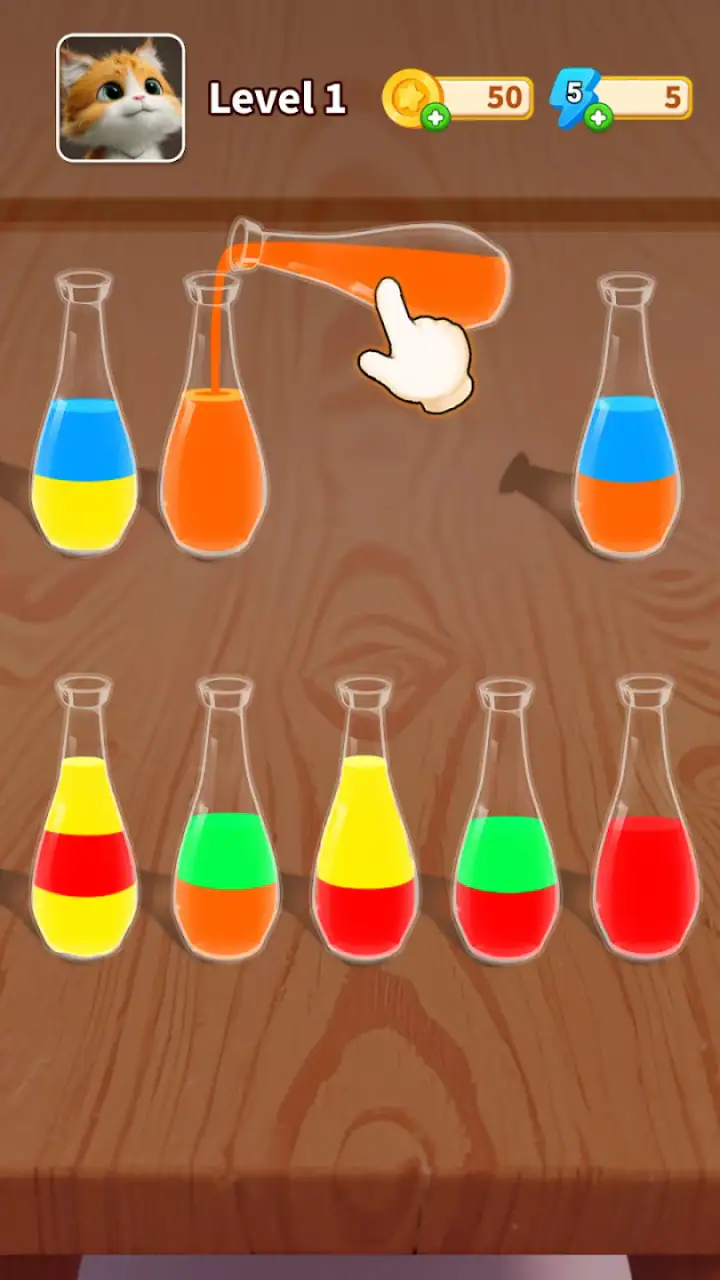
The basic interaction is easy to grasp: choose a bottle, pour into another bottle, and use empty space to separate the colors. That simplicity is important because the game does not ask me to learn a complicated control scheme before the puzzle begins. I can pick it up while waiting for an appointment, during a short break, or at the end of the day when I want a quiet distraction.
The real decision is not whether the rules are understandable. They are. The better question is whether you enjoy planning several moves ahead. A careless pour can block a useful bottle, forcing me to rethink the entire arrangement. When I play patiently, the puzzle feels satisfying because a messy group of colors gradually becomes organized. When I rush, the same board can feel like a self-created traffic jam.
That makes the game a better fit for deliberate players than for anyone looking for constant novelty. It rewards observation, sequencing, and restraint. The most useful habit is to avoid pouring simply because a move is available. Before touching a bottle, I look for the color that needs the most room and protect empty containers for later. That small change in approach makes difficult layouts feel much more manageable.
Related News

Threads in Real Life: Who Should Join, Lurk, or Leave

How SHEIN Turned Shopping Into an Endless Content Feed

How to Make Fortnite Feel Smarter on Mobile

Should You Switch to Microsoft Outlook on Mobile?
Why Gallery Keeps Pulling Users Back

X Review: Why Its Network Still Matters
What I look for beyond the basic rules
For this type of puzzle, I pay attention to three practical things: how comfortable the controls feel, how fair the mistakes seem, and whether the game works as a short-session activity. A water-sort game can be technically simple yet frustrating if taps are easy to misread or if every error feels costly. Here, the central loop remains focused on the board itself, so the experience is less cluttered than many larger casual games.
I also consider whether the format fits the player’s attention span. A round does not require a long narrative commitment, and the game can be approached in small portions. That is useful when I want a mental reset rather than an absorbing evening game. On the other hand, players who need changing objectives, characters, exploration, or multiplayer interaction may quickly find the bottle arrangement too repetitive.
One practical tip is to treat the empty bottle as a temporary workbench rather than a destination. Moving a color into it can expose a buried layer, but filling that space too early may remove the flexibility needed for the next sequence. I also try to keep matching colors together whenever possible, while resisting the temptation to complete one bottle if doing so strands another color. The best move is often the one that preserves options, not the one that looks most complete immediately.
Gallery
Who will enjoy it most
I would recommend it first to casual puzzle fans who like visual organization and gentle problem-solving. It can also suit someone returning to mobile games after a long break because there is no large fictional world to learn and no specialist knowledge required. The Everyone content rating makes it a reasonable choice for a broad audience, although younger players may still need guidance around optional purchases.
It is particularly appealing if you like games that can be paused mentally at any point. I can inspect a board, make a plan, and stop before committing to a move. That differs from timed trivia or reflex games, where the pressure comes from answering quickly. Here, the pressure is self-imposed, which is exactly why the experience can feel relaxing.
I would be more cautious about recommending it to players who want a strong sense of progression outside the puzzles. If your ideal game includes a campaign, social competition, character customization, or a steady stream of different mechanics, this may feel narrow. Its strength is concentration on one idea, and that is also the main boundary of its appeal.
Where the game wins against familiar alternatives
Compared with word trivia, this game does not depend on language knowledge or a broad store of facts. I can play it when I am tired because success comes from reading the arrangement rather than recalling an answer. Compared with match-three games, it is less about reacting to a changing board and more about committing to a sequence. That gives me more control, but it also means mistakes can be more noticeable.
Compared with idle games, it asks me to participate actively. There is no satisfaction from simply checking in and collecting progress; I need to understand the current layout. Compared with fast arcade puzzles, it is calmer and more forgiving in pace, though players who enjoy speed and spectacle may find it too quiet.
The important trade-off is depth versus variety. A focused water-sorting format can be more satisfying than a collection of shallow mini-games when I want one clear mental task. But a broader puzzle app may be a better choice if I expect wordplay, numbers, spatial challenges, and logic problems in the same session. I would choose this game for consistency, not for a wide menu of genres.
What using it feels like in everyday play
A realistic short-session example
Imagine I have ten minutes before leaving for work. I do not want to start a story game that will pull me into a long chapter, and I am not in the mood for a competitive match. I open this game, study a bottle layout, and make a few careful pours. If I reach a difficult arrangement, I can stop thinking about it and return later with a fresh view. That makes the game useful as a small break rather than something that demands a full evening.
In that situation, I would not try to solve the board by moving colors as quickly as possible. I would first identify which bottles contain mixed layers, then find the color that can be safely exposed. I would reserve an empty bottle for temporary storage and avoid filling both spare spaces with colors that cannot be moved onward. This approach turns the session into a compact logic exercise and reduces the chance of having to undo a chain of impulsive moves.
Another useful scenario is playing alongside someone without needing a formal multiplayer mode. I can hand the phone to a friend or family member and discuss the next move. One person may notice a color hidden beneath another, while the other spots a safer place to park it. That makes the game more social than its solitary format first suggests, although it remains a shared puzzle rather than a competitive head-to-head experience.
Small habits that improve the experience
My first habit is to scan the entire board before making the opening move. The first pour often determines which colors become accessible, so acting immediately can create unnecessary work. I then separate “progress moves,” which complete a color, from “access moves,” which temporarily relocate liquid to reveal something underneath. Recognizing the difference helps me avoid judging a move only by whether it fills a bottle.
My second habit is to use reversibility carefully. A pour that can be returned may still be harmful if it occupies the only useful empty space. I ask myself what the board will look like after the next two moves, not just after the current one. This is a subtle but important distinction: the game is not merely about matching colors; it is about maintaining enough room to continue matching them.
My third tip is to stop when I start repeating the same failed sequence. Replaying the identical pattern usually means I am overlooking a color order or spending the spare space too early. Taking a short break is often more effective than forcing another attempt. When I return, I can read the layers afresh instead of defending a plan that has already trapped me.
Where friction can appear
The same focused design that makes the game accessible can also make it feel repetitive. If I play for a long uninterrupted stretch, the bottle-and-color format may lose some of its freshness. This is not a defect in the central idea, but it is a real limitation for anyone who expects constant changes in presentation or rules.
There is also a difference between a puzzle being difficult and a puzzle being inconvenient. If a board becomes hard because I failed to preserve space, I generally feel responsible and willing to try again. If I am unsure whether a move was registered as intended, frustration comes from the interaction rather than the logic. For that reason, I prefer to make deliberate taps and pause briefly between pours instead of treating the game like a rapid-fire challenge.
Optional spending is another point to consider. The game is free to download, but in-app purchases range from forty-nine cents to ninety-nine dollars and ninety-nine cents per item. I would approach those options cautiously and set a purchase limit before handing the device to a child. The free entry is attractive, yet the presence of a wide purchase range means the game should be treated like any other free-to-play title: enjoy the core loop first and only spend if an optional item genuinely improves your experience.
When another category is the better choice
I would choose a word quiz instead if my main goal were learning facts, testing vocabulary, or competing through correct answers. I would choose a classic Sudoku or number-logic game if I wanted a more formal grid-based challenge with a different kind of deduction. I would choose a match-three title if I wanted quick combinations, frequent visual feedback, and a more reactive rhythm.
I would also look elsewhere if I wanted a long-term social reason to return. This game is strongest as a personal thinking exercise, not as a substitute for a multiplayer community. Likewise, players who dislike restarting a puzzle after a poor sequence may prefer a format with more forgiving, automatic recovery. The advantage of this game is concentration; the cost is that concentration remains central throughout.
Switching away is easy because the rules are not tied to a complicated progression system. If I decide that the format is too repetitive, I can move to another puzzle category without having to relearn an entire fictional universe. The reverse is also true: someone coming from an action-heavy game may need to adjust to a slower pace and accept that waiting before a move is part of playing well.
Version, audience, and value
The current version is 2.0.20, and the game was released on July 24, 2025. Those details matter mainly for readers deciding whether the title feels current enough to try. The developer is robuminer, and the game’s broad age rating makes it approachable for families and casual players who want a simple sorting challenge.
The strongest value comes from the fact that I can understand the objective immediately and still find room for better decision-making. Free access lowers the barrier to testing it, while the optional purchase range means I would keep an eye on spending rather than assuming every part of the experience is cost-free. For me, the right way to evaluate it is to play several short sessions and see whether the planning remains satisfying after the novelty of the colors fades.
My recommendation
I recommend Just Pour! - Water Sort Puzzle to anyone who enjoys calm, visual logic and wants a game that fits naturally into spare minutes. Its best quality is its clarity: I always know what I am trying to accomplish, and the challenge comes from deciding how to get there without wasting space. The game does not need a complicated presentation to create satisfying moments of progress.
I would skip it if you need story, competition, social features, or a constantly changing set of mechanics. I would also avoid treating it as a fast reflex game; the more I rush, the less enjoyable the sorting becomes. For players who like thoughtful repetition, however, the narrow focus is a benefit rather than a weakness.
My final advice is to start free, play with a deliberate pace, and use the empty bottles as planning tools instead of emergency storage. If that style of problem-solving feels rewarding, this is an easy game to keep nearby for short breaks. If you want broader trivia, richer progression, or several puzzle genres in one place, another category will serve you better. Its real strength is not endless variety, but the quiet satisfaction of turning a tangled board into a clean solution.
FAQs for Just Pour! - Water Sort Puzzle
What is Just Pour! - Water Sort Puzzle?
Just Pour! - Water Sort Puzzle is a casual color-sorting game in which you pour liquid between bottles until every container holds only one color. The gameplay is easy to understand but gradually becomes more challenging as levels add more colors, bottles, and limited spaces. It is designed for short, relaxing play sessions and does not require fast reflexes.
How do you play Just Pour! - Water Sort Puzzle?
To play, tap one bottle and then tap another bottle to pour the top layer of liquid into it. A pour is usually allowed only when the destination bottle is empty or contains the same color, and there must be enough room available. The objective is to organize all colors into separate bottles using as few unnecessary moves as possible.
Is Just Pour! - Water Sort Puzzle free to download and play?
Just Pour! - Water Sort Puzzle can generally be downloaded for free, allowing players to access its core sorting puzzles without an upfront purchase. However, the game may include advertisements, optional purchases, or other monetized features depending on the version and platform. Before downloading, check the store listing for current pricing, ads, and in-app purchase details.
Does Just Pour! - Water Sort Puzzle require an internet connection?
The main bottle-sorting puzzles are typically suitable for offline play, which makes the game convenient for travel, waiting rooms, or areas with unreliable connectivity. Nevertheless, an internet connection may be needed to load advertisements, synchronize progress, receive updates, or use certain optional features. Availability can vary by device, operating system, and the specific version installed.
Is Just Pour! - Water Sort Puzzle suitable for children and casual players?
The game is generally appropriate for casual players because it uses simple controls, clear visual goals, and non-violent puzzle mechanics. Younger children may enjoy the colors and straightforward rules, although some later levels require planning and patience. Parents should still review the app’s age rating, advertising content, privacy information, and any purchase options before allowing unsupervised use.
Pros
- Simple controls make it easy to start playing immediately.
- Levels gradually introduce new challenges without overwhelming beginners.
- Short rounds are ideal for quick breaks or casual play.
- Bright visuals and smooth animations make the game pleasant to use.
- Offline play lets you enjoy puzzles without a constant internet connection.
Cons
- Later levels can become repetitive after extended play sessions.
- Some puzzles may rely more on trial and error than clear strategy.
- Hints or extra moves may be limited or tied to advertisements.
- Frequent ads can interrupt the flow between completed levels.
- The game offers limited variety beyond its core color-sorting mechanic.


